|
2, 4, 6, 8. Which One Do You Appreciate? Smith and Wesson .357 Magnum - By: Randall Graham 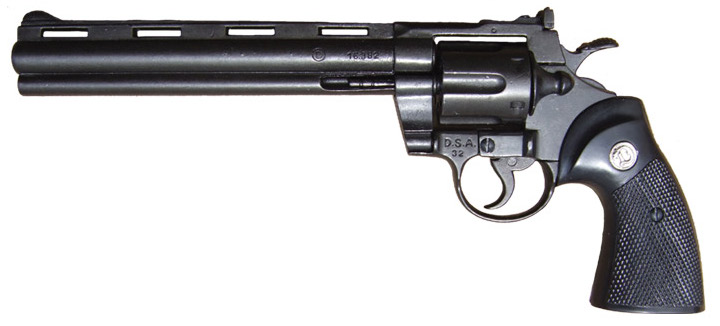 The famous Smith and Wesson original .357 Magnum Revolver was developed primarily for use by law enforcement personnel. The first registered Magnum was presented to the FBI's J. Edgar Hoover. In 1935, at the height of the Great Depression, Smith and Wesson began production of the .357, even though they feared they would have a lackluster response to the pistol's introduction, because of the high production cost which had to be passed on to buyers. The Magnum was much more expensive than other pistols of its day. The economic restraint of the Depression didn't help. For these reasons, their original plans called for a limited production run. To their surprise, demand for the .357 Magnum Revolver far exceeded their expectations--so much that they stopped engraving individual serial numbers on the pistols and issuing certificates of authenticity. They had to do away with the original plans for a limited production run. Because of the lack of identifying marks, to this day, there is confusion identifying all the different models they produced. The .357 Magnum was later designated the Model 27, based on its predecessor, the .38 caliber N-Frame. But you'd have to be a real specialist in order to identify some of the models that are still in circulation. Like most arms producers, Smith and Wesson produced such a wide range of models and variations and in different calibers, that it can be a challenge just keeping track of them. The advent of the automobile had given criminals a new weapon, and accounted for the runaway popularity of the Magnum. When confronted by police, bank robbers, gangsters and other miscreants could simply hide behind their car doors and blast away. Police officers liked the .357 for its raw stopping power, and its ability to penetrate car doors and bullet-proof vests, and still stop or kill the unlucky target who was unfortunate enough to find himself looking into the business end of the Magnum. This made the gun a favorite for battling heavily armed gangsters. No doubt it was the favorite of a few criminals too. Certainly it was a lot easier to conceal in a pocket than the Thompson Sub-Machine Gun--another gangster favorite--which couldn't be hidden in anything smaller than a violin case, and packed no less punch than the Thompson. The Magnum was produced in 2, 4, 6 and 8-inch barrel lengths, and several others in-between. Each model provided different levels of accuracy, weight, or concealability, depending on the preference of the user. There is no question that the classic eight-inch barrel, large-caliber Magnum revolver is a formidable and intimidating weapon--almost like a hand-held cannon. But the 2-inch barrel version was nothing to sneeze at. It still packed a punch, and was easier to conceal. Production of the .357 Magnum (Model 27) continued until 1994. It was reintroduced in 2008 due to popular demand by enthusiasts. You just can't keep a good gun down. The .357 Magnum cartridge is basically an elongated version of the .38 caliber. This makes for a lot more powder, which translates into more punch, velocity and range. It is probably the most powerful cartridge ever made for a handgun, or among the top few. How could Dick Tracy be wrong? While the .357 Magnum revolver made for a great police firearm, most law enforcement officers now use the more modern automatics. From my own personal observations, I see a lot of Glocks among police officers. Even though the revolver is mostly old school, having given way to sleek, even robotic-looking automatics, there is still a large cadre of revolver aficionados out there. The Smith and Wesson .357 Magnum lives on. The famous Smith and Wesson original .357 Magnum Revolver was developed Randall Graham is an internet marketer and author and fan of history. He is also a co-author of the blog, "The Non-Smoking Gun". Reenactors, history buffs and gun fanciers will find authentic non-firing, black powder and blank-firing replicas of historic and classic firearms of the American Revolution, Civil War, Old West, both World Wars and the 20th Century at GunsOfOld.com. Other items of interest include Old West badges, Civil War and World War reenactor gear, holsters and other leather goods. |