

 On eBay Now...
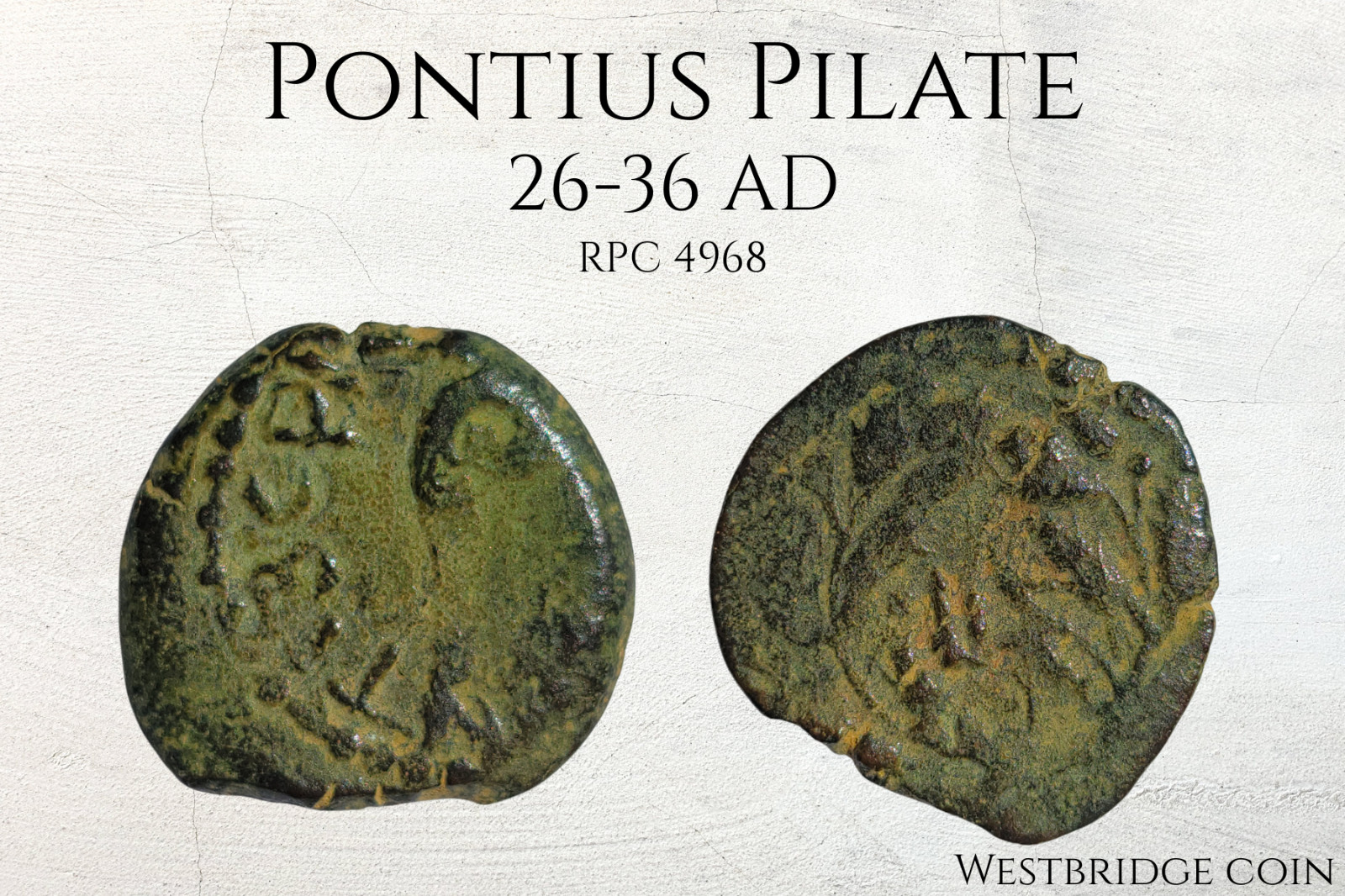

Upright lituus, the curved staff associated with Roman augurs and religious ceremony. The surrounding Greek legend names Tiberius Caesar. Reverse L I Z within a wreath. The inscription dates the coin to Year Seventeen of the reign of Tiberius, corresponding to 30 AD. ✦ Year Seventeen — 30 AD
The date is one of the most historically interesting features of this issue. The letters L I Z record the seventeenth regnal year of Emperor Tiberius, which Roman Provincial Coinage dates to 30 AD.
That places the coin securely within the governorship of Pontius Pilate and within the historical period in which the New Testament places the trial and crucifixion of Jesus.
Pontius Pilate Roman Prefect of JudaeaPontius Pilate governed Judaea for approximately a decade, from 26 to 36 AD, under Emperor Tiberius. His official title was Prefect of Judaea.
The provincial capital and principal headquarters of the Roman governor were at Caesarea Maritima, although Pilate traveled to Jerusalem when circumstances required a Roman administrative or military presence.
Pilate appears not only in the Christian Gospels but also in ancient Jewish and Roman historical traditions. His name is additionally preserved by the famous Latin inscription discovered at Caesarea Maritima, providing archaeological confirmation of his prefecture.
✦ Pontius Pilate in the New TestamentPontius Pilate's lasting historical and religious importance comes above all from the Passion narratives of the New Testament. The canonical Gospels describe Jesus being brought before the Roman prefect in Jerusalem after his arrest.
Pilate questioned Jesus and ultimately authorized his crucifixion. The Gospel of Matthew contains one of the most famous passages associated with the Roman governor: Pilate takes water and symbolically washes his hands before the crowd.
“I am innocent of the blood of this just person: see ye to it.” — Matthew 27:24, King James VersionWhatever interpretation is placed upon Pilate's actions in the Gospel accounts, his role in the condemnation and crucifixion of Jesus made his name one of the most enduring Roman names in Christian history.
30 AD & the Date of the CrucifixionAll four canonical Gospels place the Crucifixion during the prefecture of Pontius Pilate, and historical chronology firmly places Pilate in office during this coin's issue.
The precise year of the Crucifixion remains debated. 30 AD and 33 AD are the two principal dates proposed by modern scholarship.
This coin is dated specifically to 30 AD. It should therefore not be described as certainly struck in the year of the Crucifixion, but it was issued in one of the principal years proposed for that event and unquestionably during Pilate's prefecture.
✦ Condition Condition: About Fine/VF.This coin has not been graded by a third-party grading service. Any grade, condition, or descriptive wording is the seller’s opinion only and is not a professional grade, guarantee, or prediction of how NGC, PCGS, ANACS, ICG, CAC, or any other grading service may evaluate the coin. Grading is subjective. Please review the photos and video, where available, and make your own judgment regarding condition and overall appearance before purchasing.
Ancient coins were individually struck by hand. Differences in centering, flan shape, patina, deposits, wear, and surface characteristics are normal features of ancient coinage. Please examine every listing photograph carefully when evaluating condition and appearance.
✦ Roman Judaea Judaea and neighboring territories during the first century AD Roman Judaea during approximately AD 6–41, including Jerusalem and the provincial administrative center at Caesarea Maritima. Pilate in Christian ArtCenturies after the Roman prefect's lifetime, the encounter between Pilate and Jesus became one of the most frequently depicted episodes in Christian art. Antonio Ciseri's nineteenth-century Ecce Homo portrays Pilate presenting Jesus to the crowd, inspired by the Gospel of John.
Antonio Ciseri, Ecce Homo, 1871. A later artistic interpretation of Pilate presenting Jesus before the crowd. ✦ A Coin of Roman Judaea in 30 ADThis small bronze was issued under Pontius Pilate at Jerusalem during the reign of Tiberius. Its date places it within the same narrow historical period in which the New Testament sets the trial and Crucifixion of Jesus. It therefore connects the everyday provincial coinage of the Roman Empire with one of the most influential periods in the religious history of the ancient world.
WESTBRIDGE COIN ✦ ✦ ✦ Historical imagery is included for educational and historical context and is not part of the item offered. Pilate inscription photograph: Marion Doss, CC BY-SA 2.0.Roman Judaea map: DEGA MD, CC BY-SA 4.0.
Antonio Ciseri, Ecce Homo: public domain.





