

 On eBay Now...
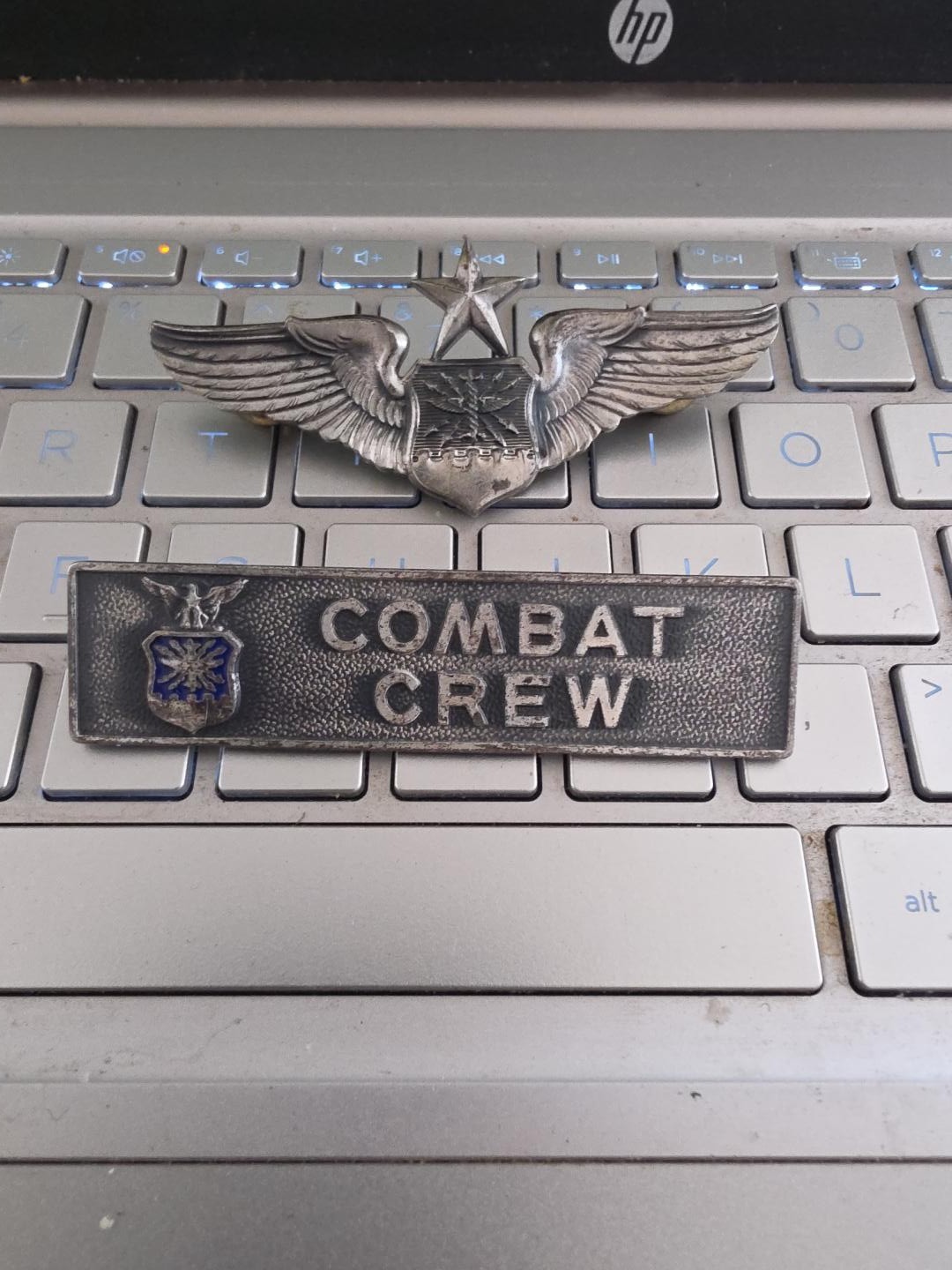

TWO VINTAGE U.S. AIR FORCE STERLING SILVER BADGES — N.S. MEYER, NEW YORK — FULL-SIZE 3-INCH SENIOR NAVIGATOR WINGS & COMBAT CREW INSIGNIA
A BEAUTIFUL PAIR OF COLD WAR / VIETNAM-ERA AIR FORCE INSIGNIA — FULL-SIZE, MAKER-MARKED, AND OFFERED AS STERLING SILVER
Here is a very attractive two-piece collection of genuine-style United States Air Force qualification insignia from the era when navigation, crew readiness, and the strategic air mission were central to American defense. Both pieces are full-size, approximately THREE INCHES across, with carefully detailed metalwork, old-style military finishes, and the maker’s name N.S. MEYER, INC., NEW YORK on their reverses.
N.S. Meyer was one of the best-known American suppliers of military insignia during the twentieth century. Collectors of Air Force wings recognize the Meyer name, shield trademarks, and older sterling-silver construction as features worth seeking out.
Both badges are offered together as one collectible lot, exactly as shown.
- U.S. AIR FORCE SENIOR NAVIGATOR / SENIOR AIRCRAFT OBSERVER WINGS — STERLING SILVER
The impressive upper badge features a pair of extended, finely feathered wings embracing the shield of the United States Air Force. Above the center is a large five-pointed star. That star is the key to identifying the rating: these are SENIOR NAVIGATOR / SENIOR AIRCRAFT OBSERVER wings, not ordinary basic-grade wings and not a Senior Pilot badge.
The center shield incorporates the Air Force’s distinctive heraldic design, including the winged thunderbolt representing air power. The star above the shield marks achievement of the senior aeronautical qualification. The Navigator / Aircraft Observer insignia grew out of the separate flying specialties of World War II and became part of the independent U.S. Air Force’s postwar identification system.
The men who earned navigator ratings were essential to military aviation. Before satellite navigation and modern automated flight systems, they helped crews find their way across vast oceans, remote terrain, and contested airspace. Even as electronics improved, navigators and specialized aircraft observers remained key members of bomber, reconnaissance, transport, and other Air Force crews.
This example measures approximately three inches wide and has two clutch-back posts and fasteners visible on the reverse. The old silver-toned patina and strong three-dimensional feather detail are particularly attractive. The reverse is marked N.S. MEYER INC., NEW YORK and STERLING, along with the maker’s shield-style trademark. A sterling hallmark indicates an alloy traditionally containing 92.5% silver, not merely silver plating. The exact manufacturing year is not stamped.
- U.S. AIR FORCE COMBAT CREW MEMBER BADGE — FULL-SIZE THREE INCHES
The second badge is a substantial rectangular metal bar bearing the deeply raised words COMBAT CREW. At its left is a small, blue-enameled shield displaying the United States Air Force heraldic emblem, surmounted by an eagle.
This badge has a fascinating, specific history. The United States Air Force formally established the Combat Crew Member Badge effective SEPTEMBER 1, 1964. Unlike an award medal presented for a completed act, it was a qualification and duty-status badge identifying eligible personnel currently serving in qualifying combat-ready aircraft or missile crew positions. It was closely connected to the Air Force’s Combat Readiness program and the demanding work of maintaining an operational force prepared for immediate missions.
That 1964 authorization places this design squarely in the Cold War and Vietnam-era world of long-range bombers, reconnaissance aircraft, missile operations, and military readiness. The Combat Crew badge was eventually eliminated from authorized uniform wear in 1993. That gives the design a defined period of official use, though an exact manufacturing date for this example cannot be established by appearance alone.
The full-size three-inch format follows the original Air Force specification for the badge, which called for oxidized sterling silver with a blue-enameled shield. The reverse carries the N.S. MEYER INC., NEW YORK maker mark and small shield marks. The separate STERLING wording is clearly visible on the wing badge; on the Combat Crew bar, it is not clearly legible in the supplied reverse photographs, so the bar’s metal content is stated as the seller’s sterling-silver identification, consistent with the official period specification.
CONDITION — PLEASE READ
Both pieces show age, darkening, tarnish, and honest surface wear, particularly on the backs. The wing badge retains its two clutch-type fasteners. The Combat Crew bar appears to retain one clutch fastener, while the opposite fastening point may need a replacement clutch or further inspection. Please study the close-up photographs carefully and do not assume the bar has two complete matching clutches.
No named airman’s provenance or proof that both insignia were worn by the same individual accompanies this lot. They are offered as a collector’s two-piece pairing.
For a serious collector of American aviation insignia, N.S. Meyer military badges, early sterling Air Force wings, or Cold War and Vietnam-era history, these two attractive full-size examples would make an excellent display.
YOU WILL RECEIVE BOTH BADGES PICTURED. Thank you for looking and happy collecting!
PLEASE SEE STORE WW1- WW2 MEDALS -STERLING SILVER BADGES - RARE COINS PCGS GRADED /RARE GRADED CURRENCY





